It's well into February. Hard to believe that I've been in Mali for almost 7 months already; I have 19 more to look forward to. After returning to site post-IST, project implementation has been in full effect. I was a bit nervous at first proposing my ideas for potential projects, as I've been sitting in village learning Fulfulde for 3 months straight. In terms of getting work done, I hadn't accompolished anything (don't worry.... it's not due to lack of motivation, it's the Peace Corps' rule). I practiced speaking about the projects to myself and my to my PC friends in Fulfulde before unveiling them to the villagers, and I worked out many kinks in the language. It's amazing how much a dictionary helps here. For the last week, I have been holding meetings at various places around the village in order to gain support for the projects, organize material lists, translate work between English and Fulfulde and back again. I pretty much just jumped into the work instead of trying to get my feet wet first. This has been a surprisingly easy transition and everyone I am working with in village is more than motivated to get going on the projects.
For the millet field test projects, I have already singled out 4 farmers to work with, devised a tentative work schedule, worked out cost benefits, and have made plans to store successfully grown seeds in the seed bank to sell to other communities the following planting season. That works out the best because it allows me to take out two projects in one. Those would be finding a drought resistant millet strain and updating the seed bank. Check.
Furthermore, the cereal bank project is going faster than I had imagined and is actually going to be a hell of a lot easier than I had initially thought. There is a pre-existing structure in village that housed grains at one point until the ceiling caved in (this happens often, as the homes are made of rocks, sticks and mud). We measured the dimensions of the building and plan to tear it down in the coming weeks and build a new one in it's place to roughly the same dimensions. This makes my job easier, as funding projects in Mali requires a minimun of at least 25% contributions from the village. My village will be supplying all of the rocks for the structure, all of the wooden cieling beams we salvage, all of the workers and hours. a strong metal door from the existing structure and will hopefully be able to kick in some grains. When I write up the proposal, I need to create a very specific materials cost and needs sheet that is divided up into community contributions and monies requested. This is well under way, in both Fulfulde and English. It's been difficult work, but has been keeping me very busy... obviously a big difference from the initial 3 months in village. Basically, the village will need the money for bags of cemement, record keeping materials, a new lock, scales, cereals, bags, lamps, etc. This is much less than I had originally thought.
I spoke with my APCD (Oumar, who is in charge of the Ag sector) today and he is thrilled to see that my work is taking off so quickly. He put me on a list of seed recipients for the millet field testing, but I want to call the project manager directly in order to ensure I get exactly what I need. We're looking for varieties that will seed in roughly 60-75 days, as we don't get much rain here. I also told him about the cereal bank project and asked about funding opportunities. More specifically, I wanted to know if the Peace Corps funding options covered the cost of the grains that will be stored and sold in the bank. He said it coveres everything as long as the commmunity contribution is at least 25%. So, I'm set there. Also, I met with a local NGO today and pitched my projects to them. They were very positive about my work and would like to collaborate on projects in the future becasue I live in village and am a valuable resource. We spoke about the cereal bank, and they have actually funded, built, and stocked multiple cereal banks in the Douentza area. They are willing to work with me on that project, so that's another win for me.
These projects will keep me busy through the next harvest season (until about December). After that, I will begin gardening projects during the next cold season with the villagers that are aimed at income generation. Really, I just want to grow vegetables to eat that aren't onions. I could go for some carrots about now.
In other news, Mike and Zack bought their tickets and will arrive in Bamako on June 12. They'll be in Mali for roughly 3 weeks, so I have a lot of planning to do before they get here. Also, I'm going to Bamako for more training in early April, and hopefully after that, taking a trip to Ghana with some friends to escape the hot season and get to the beach. I'm going to need a vacation by that point. I can tell that the hot season is inching closer and closer because it is getting near 100 degrees by mid day and I can't sleep inside anymore. My house is just rocks that bake in the sun all day. Funny how they showed us how to build a heat conserving mud brick stove that is built just like my home.
11 February 2008


19 January 2008
What is Dave gonna do?
After 2 weeks of training, I'm finally done and my head is full of ideas. The question remains: What do I do next? Well, to begin I am going to travel back north relatively slowly. Tonight, I am going into Bamako in search of a hot shower ("Insh Allah!"), American food and a beer. I'll spend two nights at a hotel and then take a 10-12 hour bus ride to Sevare on Monday morning. When I get to Sevare, my first project will begin. My buddy Phil and I have decided to go hunting for supplies to build solar food driers. We have two different plans, and aren't sure which one is better. The plan is to build both of them and try them out... a little experiment with fruits. Solar drying will be a small income generating activity (IGA) that I hope to introduce to the village. Already, my village grows mangoes, papayas, bananas, guavas, onions, garlic, etc. The problem is that they eat them right away. When they're gone, they're gone. By introducing a solar drying technique, the villagers will be able to conserve fruit for later consumption (benefit = intake of vitamins at a later point) and/or be able to sell them in the various surrounding markets. Now, I am unsure how well they will sell, but it is worth the try. I figure that I will fund the first solar drier, as it will only cost a few dollars to build. Once I make it, I will bring it to village, teach the people how to use it and tell them what the benefits are. If they are interested, I will then offer instructions on how to build one for themselves. There is a village 10km away that sells bamboo at an extremely low cost; just a short donkey cart ride away! I will speak with the man that sells bamboo and builds bamboo furniture about the feasibility of providing wood and/or building the driers himself. Either way, he makes money... added business.
Next comes the BIG project! Well, one of the big projects. I have spoken with ICRISAT, an experimental agricultural organization. They have been developing millet varieties that are drought resistant, have higher yields, seed faster, grow bigger, etc.... basically they are attempting to create super-millet without the use of chemicals. They want to work with Peace Corps volunteers and their communities in order to test out the millet varieties in the different regions throughout Mali. As of yet, I don't think any one has tested the millet varieties up north yet. My plan is to speak with the main families in village and convince 4 of them to share a plot of land with me (roughly 1/2 a hectare each). These plots will all have to be pretty homogeneous in terms of soil condition, shade trees (preferably none), compost composition, water availability, etc. Once I determine where the 4 plots will be, I will divide the 4 plots into 5 subsections. I hope to acquire 4 super-millet varieties for each plot, plus use the local variety as a constant (I get to play scientist! Who would have thought?). In terms of organization, this is going to be a huge project to get running. Everyone is going to have to be convinced to donate land for the experiment and be dedicated to working equally as hard. The variables really shouldn't be changed between plots in order to get consistent results. The project comes with a few guidelines, but it gives a good deal of leeway. The benefits of this project are that, if successful, the village will have new and improved millet varieties that they can eat and/or sell to generate a small income. As they will be receiving the initial seeds for free, I hope that they will also pass some results on to other farmers if their is a high success rate. I will begin organizing this project as soon as I get back to village, writing up a proposal in about a month, receiving seeds around April, tilling the soil and composting through May, planting in June/July, weeding the fields until September/October, and harvesting sometime in November (so Allah jabbi). Phew... it's gonna be a lot of work!
In terms of other projects, there is also the cereal bank that I want to build, but I don't have enough information on that yet. When I get back to village, I will organize meetings to determine who will be responsible for forming the association needed for the bank. Once the association is formed I can then work on drafting a funding proposal. If anyone wants to donate, I will be putting the draft up on the Peace Corps Partnership Program website. This won't be for a while, but keep your eyes open! I will have a lot more info on this subject and how it will benefit the village within the coming months.
There is also the seed bank that needs to be updated. Since I've been in Bamako, I picked up some baobab, jatropha, moringa, and Senegalese acacia tree seeds. It will be nice to go back to village with something tangible. Also, I have learned valuable gardening techniques that have to do with composting, raising soil fertility, erosion control, channel irrigation, aeration, etc... that I hope to implement when I return. I really just want to grow some carrots, actually. I also have ideas in my head about building a library and additional school building in Beguma, getting 4-6 India/Mali pumps for the well in my village, and a trash collecting campaign in Douentza. I probably have too much on my plate as it is now, but it is good to have available options in case of failure or if the villagers aren't motivated towards a certain idea. I will learn to practice patience, flexibility, and motivation over the coming months.
17 January 2008
Info for Mrs. Kelley
After all these years, we're reconnected! And, I don't even have to stand on my head and spit wooden nickles! You didn't leave a contact e-mail on the blog, so I am hoping that this will be effective. Yes, I am interested in keeping contact with students at St. Francis. There is a program through the Peace Corps called the Paul D. Coverdell World Wise Schools Program. It connects volunteers around the world with students and teachers back in the States. I have not fully looked into the program, but I know it works more effectively when the volunteer sets himself up directly with a teacher. Also, I'm pretty sure that the Peace Corps reimburses postage (always a plus!). If your students are at all interested in learning about Malian culture, the education system, agricultural practices, or even just life in general, I would gladly correspond with them. You can contact the Peace Corps through this website (http://www.peacecorps.gov/wws/), or we can just write back and forth... depending on if you would like the formalities or not. The Peace Corps may even send you educational supplies for you and your students, so it is definitely worth looking into. St. Francis provided me with a strong educational background; therefore, I look forward to giving back any way I can... except monetarily at this point! Also, there is a village next to mine where the students are beginning to learn English. Perhaps they will be able to write as pen pals with the students at St. Francis if their English improves. If not, I am friends with the teacher, and I am sure he would be thrilled to act as translator in order to bridge the cultural and language gap. The students could learn so much from each other. Contact the Peace Corps from the website or send me an e-mail/regular mail with details.
My e-mail is: davemunsell@hotmail.com
Or you can write to:
Dave Munsell, PCV
Corps de la Paix
Douentza, Mali
West Africa
My e-mail is: davemunsell@hotmail.com
Or you can write to:
Dave Munsell, PCV
Corps de la Paix
Douentza, Mali
West Africa
12 January 2008
A jour e bon?
I'm back at the Peace Corps training center for two weeks of Agricultural/French/Fulfulde lessons and it is awesome. I am eating really good food. I had green beans today and nearly peed myself with joy. Back in, say 1992, had my Mom said, "David James, you're going to eat this green beans now because one day you won't have them and you'll even crave them," I would have called her a big liar and said I was just gonna eat my french fries and candy bars. Well, those green beans today definitely filled my belly with pure food-joy.
I have been here a week and am looking forward to another week because the food and company is just so easy to appreciate. In the Peace Corps, the number one lesson to learn is the value and quality of what you normally take for granted (such as green beans!). When you're at site out in the sticks eating "To," reading by a kerosene lamp and listening to people you barely know babble on in Dogon in front of their rock houses, you can only imagine how good a burger, a beer and someone to speak English would be at that time. Comfort food has a way deeper meaning for me now.
Besides the food (can you tell how happy it makes me?) I am actually learning a lot of really practical information that I will bring back to site and implement there. My first goal is to train the villagers to make and use compost. As of now, they take straight up cow poop and just place it on the fields. Generally this adds too much nitrogen to the soil and causes the plants to turn yellow and "burn." Although making compost seems like such a simple and small project, it is the education of the villagers that will be the toughest part. I have to convince them that this project, even though it will tend to be more labor intensive, is actually worth the extra effort. If you've kept up with this blog, you'll remember I wrote about the experimental Farmers' Field School. With compost, this is were I will finally be able to test out the theory/practice.
The other day we built a water containment cistern out in the garden from a mud brick form, chicken wire and mortar. Getting the mortar to stick to the chicken wire was the most difficult part and it took me a good 20 minutes to get the right wrist/arm motions down. Had I built a cistern in village without any prior experience, I would look like a complete jackass trying to toss mortar onto the frame. This is the best part of IST. The Peace Corps training staff has prepared a full schedule of programs to train us on. We are able to do all of the activities through a hands-on process in order to work out the kinks and learn how to create them successfully. Over the next few days there will be more training as well as developing a calendar for the next 3 months at site until the next IST. I haven't given my individual site calendar too much thought, but I have many ideas floating around in my head. I'll write it up later in the week when I have a more concrete idea.
27 December 2007
Merry Christmas
The Peace Corps is aging me... I look older than my 23 years. I don't really have a mustache, though... that's just from lack of shaving regularly.


Christmas rocked in Mali. I rode a camel (which is seriously uncomfortable), slept on the fringe of the Sahara Desert (which is seriously cold), and rode fast in an offroad vehicle (which is seriously bumpy). All in all, it rocked.
I celebrated the Tabaski/Li-ah/Eid/Muslim New Year in my village and I ate more meat than I have in one day than in all 5 months here combined. My village slaughtered around 40 animals (which is seriously bloody!) and roasted them all throughout the day. That's a lot of meat for around 200 people. Between all the meat and around 15 rounds of Malian tea, my body was wracked and I didn't sleep that night. The villagers doned their finest white robes and went out into the fields to pray during the morning. Following the prayers, we all went to the local imam's house where he slaughtered lambs and goats, then to the local chief's house where he slaughtered more animals and people tooled around on motorcycles. Then, the slaughtering culminated in the slaughtering of a cow and lots more sheep and goats at my jah tigi's (host family) house.
I am going back to village this afternoon for a few days and will return to Douentza for New Years. After that, it's on to Bamako for In Service Training and hopefully some Americanized Food.
I read a quote from a Peace Corps Volunteer in Ethiopia in the 1960s. It was something along the lines of "I respected the Ethiopian customs and culture, but I could never fully adapt. I am just an incurable American!" That's me. As much as I enjoy village life, I can't stay away from Douentza where there are some modern amenities (although I still lack electricity and running water), I'll never wear the Malian clothing again, I cook semi-American food almost daily, I value American contacts (as I don't have to explain myself because the cultural values are innate), etc.
In other news, I have adopted the Peace Corps Stare. Upon first arriving in Mali, I noticed something odd and spacy about the current volunteers. I couldn't quite place it, but something was definitely different with these people who had lived in Mali for an extended amount of time. Speaking with the current PCVs, it was difficult to get their attention at times, as they would be staring off into space lost in some unseen fog. This is the Peace Corps Stare and it comes from spending hours, days, weeks, and months as the solitary American in a village where you are constantly lost in thought. You are able to tune the world out and find some comfort within the deepest recesses of your mind when you can't figure out what is going on around you... this happens way more often than you can imagine. The Peace Corps Stare is pretty serious and it can be difficult to get the attention of someone caught deep in it. It's almost like a zen/trancendental activity where you become completely immersed in your thoughts and leave the physical place you're actually in. I've been caught in this Peace Corps stare and my villagers have to scream "Amadu! Amadu! Ada milla faa hewi!" (Amadu you think too much!) in order to get my attention. It can definitely take some work to get me back into reality from the Peace Corps stare! This is definitely a useful tool I have adopted in order to pass the time at site and on those terribly uncomfortble bus rides.
Have a great New Year! This post is sporadic and doesn't make much sense or explain too much, but that's where I think I'm at right now. Hopefully I can find a faster computer to post more pics, as I have tons of awesome new ones.
14 December 2007
Quick Post
I climbed the mountain, and it was awesome. I didn't think I would be in Douentza right now, so I didn't bring my camera. I will get pictures up at some point because there are some wicked good ones. I climbed with Eric from Nebraska and Fikru from Colorado. He camped in a cave, had a bon fire, drank some cheap whiskey out of plastic bags, and listened to country music while warding off imaginary hyenas with hollers, whoops and my big machette! There could have been hyenas... I think our fire, noise and big knife just scared them off. We WERE camping in a cave in the middle of Africa!
I wrote an e-mail to Dylan today and I am gonna post it here because it gets some points across about prospective Peace Corps service and may give some people a better idea of my life here. Hope he doesn't mind me posting it.
"what up?
Good to hear from you. You're seriously applying for the Peace Corps? That's awesome. We're gonna have to have a long talk on the phone sometime so I can explain many things to you. What I can tell you right now though is that the Peace Corps is the most contradictory life experience you'll ever have that combines the lowest of lows with the highest of highs that equal up to one wild emotional rollercoaster. I've only been here 5 months, and I have 21 to go, but I feel like I've lived an entire other life since I arrived. My thoughts, rationals, opinions, values, and everything else have all changed. I hope for the better. I have really learned to slow things down and take life as it comes, as I have FAR too much time to sit, think and refelct upon the past events of my life. It is one hell of an adventure and I am enjoying it thoroughly... minus becoming violently ill and having delirius fevers from time to time (they can be scary sometimes... combo of crazy malaria meds and high fever delirium equal really bad drug trip from a movie!) Combine the lows of the sickness, lonliness, feelings of isolation, etc with the highs of climbing mountains, speaking multiple languages, experiencing new cultures, and generally rocking and rolling and you can almost begin to understand the contradictory emotinoal rollercoaster that is Peace Corps life.
Apply sooner than later so that you can hone in more on what you want. I was too eager to just begin my service and took the first prospect that came. Had I waited, I may have got South America. I have actually forgotten almost all of my spanish now! My head is full of Fulfulde, Bambara, Dogon and French... I hope I don't forget English next! I spoke a little spanish today. but it was harder than pulling teeth. Anyway, as to getting what you want out of the Peace Corps app process, it is wierd how things work out. I am very happy in Africa. I love my village (we grow some tasty mangoes and guavas), have made awesome friends, have seen some terribly amazing sites, and opened up possibilities that I never knew were possible. Africa is poor, but the hope, happiness and resilience that the people harbor here is beyond words. It's just incredible. Strive for what you want, but if you don't get it, just go with what you get. It should work out. The Peace Corps is an amazing way to discover not only the world, but yourself as well. I read yesterday in a Hemingway book that traveling to different, exotic lands will not change you nor erase your problems because you are who you are. This is true to an extent. What you can attain from travel is a broader base to build upon. You can take everything in that you see, hear, touch, and smell and use it create your life the way you want. The Peace Corps is a great way to site back from 2 years, build up your resume, learn an incredible amount, hone in on what you want out of life, mature, and focus yourself.
I wish you luck and please feel free to send me questions any time. I hope this e-mail helps you out. Good luck with finals coming up and tell everyone i said hey when you see them over winter break. Hit up some mountains for me, as I won't see snow for another 2 years! If you need a friend to write a recommendation for you I will gladly write it up over the internet. who knows, maybe having an official PCV speaking on your behalf will give you some weight!
-Dave"
Take care everyone!
03 December 2007
 Here is the mountain we're climbing next weekend!
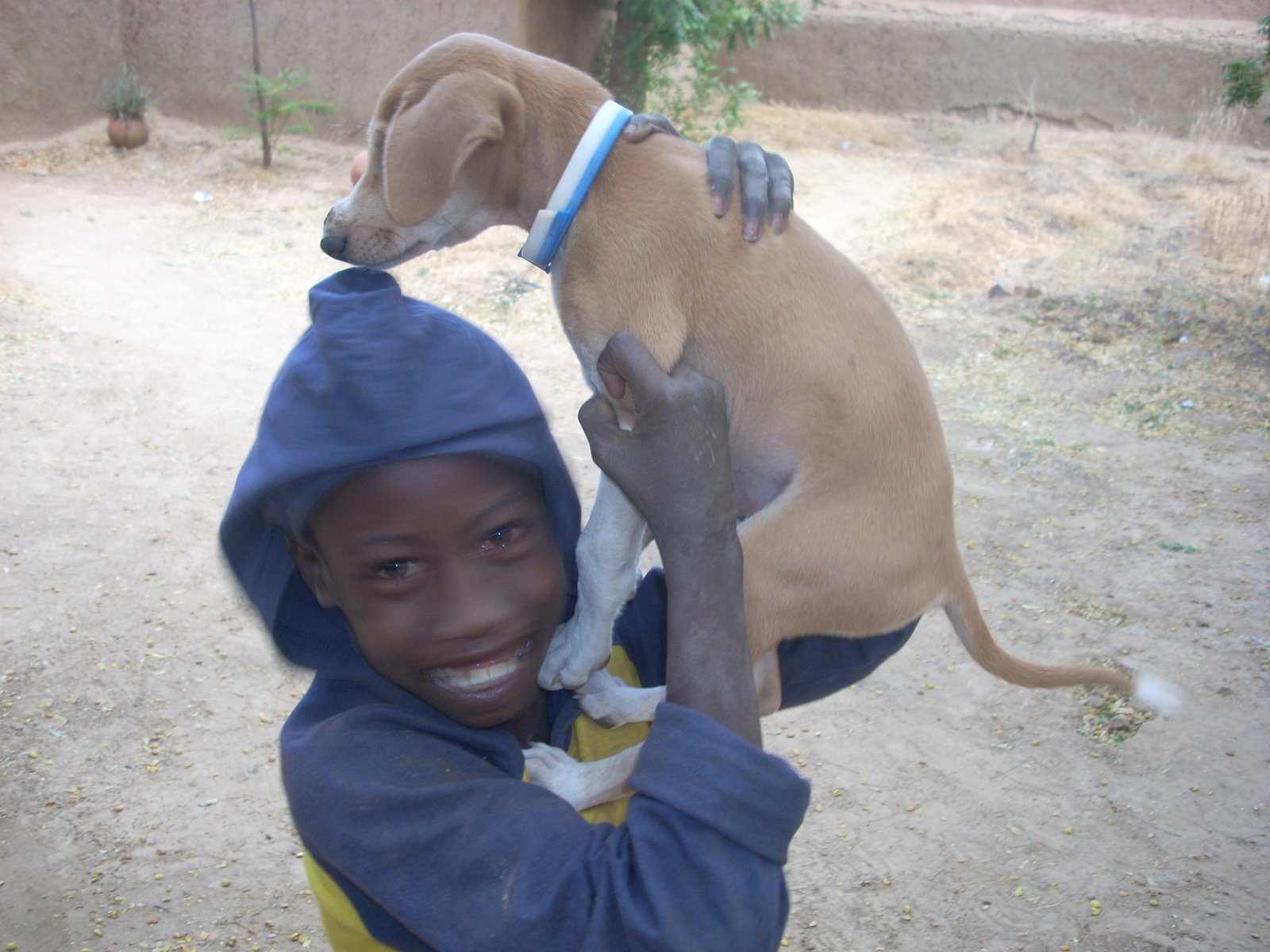 This is my buddy Salif playing with Rufus. I think he's like 12 years old. The kid studies the Koran and speaks about 4 different languages... he is very bright and helps out when we us PCVs are in Douentza.
 This is me and Rufus hanging out in Douentza... as you can see he really likes to gnaw on my hand.
I start teaching English tomrorrow... I have never taught before, so this should be a trip. Ha teaching English through Fulfulde!
Subscribe to:
Posts (Atom)


